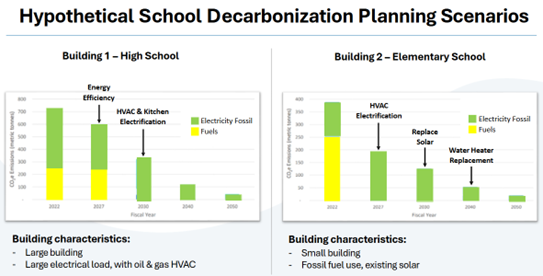

The Massachusetts School Building Authority (MSBA) hosted a virtual program on May 7, 2025, highlighting three separate paths that three school districts took to upgrade school facilities in rural MA districts. The agenda included an overview by Superintendent Sheryl Stanton specific to the struggles that her rural community and others face, including declining school age population, aging school infrastructure and decreased property values. These and other factors combine to work against a community’s ability to plan and fund large-scale capital improvements for schools. Three Central and Western Massachusetts districts presented their building improvement solutions for consideration, including upgrades to HVAC as well as whole scale improvements to learning environments. Each project solution upgraded heating and cooling systems for better air quality and thermal comfort; and each project solution resulted in outcomes that are less reliant on fossil fuel. The highlighted projects are reaping the benefit of lower facility operational costs districtwide.
Information on sources for State funding to assist with project cost of capital upgrades was also included in the morning program, specifically from MassSave, MA Clean Energy Center (MA CEC) and the Massachusetts School Building Authority (MSBA).
The MSBA welcomed officials from 23 school districts across Massachusetts for the half-day program. It featured presenters from Mohawk Trail/Hawlemont Regional Public Schools, Northampton Public Schools, the Town of Orange, and the City of Westfield. To round out the discussion focused on planning, implementing, and affording facility upgrades in rural public schools districts, industry professionals and the MSBA offered attendees information about funding opportunities to assist with project planning, design and cost.
Welcomed first by MSBA Chief Executive Officer and First Deputy Treasurer, Jim MacDonald, Session One began with a brief overview of one rural community’s challenges. Sheryl Stanton, Superintendent for the Mohawk Trail/Hawlemont Regional Public Schools, shared the results of a study conducted to capture the impact on education now and in the future that declining enrollment and stagnant property values have on her sprawling school district. Specifically, her regional school district covers over 250 square miles, serves eight towns, includes five deteriorating school buildings and educates enrollment of only 900 students. Superintendent Stanton shared that maintaining quality education for students in schools that are well undercapacity is not optimal. These challenges prompted officials to undertake the study, the results of which have been helpful to educate citizen stakeholders about the issues and possible solutions.
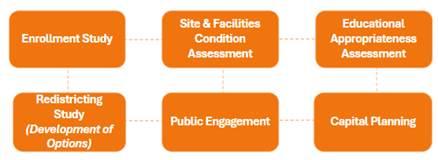
Concluding the first session, Dorrie Brooks (AIA), Principal Architect of Jones Whitsett Architects shared her thoughts on an important first step to starting down a path for an improvement project. Specifically, developing a Master Plan that assesses building stock and incorporates the expected lifespan of building components is helpful to determine project priorities.
Another aspect of this assessment could include an “educational appropriateness assessment.” This type of assessment inquires whether your educational facility matches your educational vision. Does your facility have adequate power and infrastructure, varied space sizes to support academic intervention near the classroom, appropriate workspaces for all staff members and up-to-date specialized instructional spaces for Arts, STEM, Phys Ed and Vocational? A recently completed school designed by Jones Whitsett Architects for the City of Gardner, now offers students and teachers a facility that meets the goals of the educational appropriateness assessment. It demonstrates the benefits of consolidating several older elementary schools into a single new school that retains small communities within it.
Dorrie emphasized that a comprehensive master plan for a school includes conclusive building and site assessments, a clear and inclusive educational vision, and transparent, authoritative data to present to key stakeholders regarding operational cost projections.
Pathways
Beginning with Ben Weil, Director of Climate Action and Project Administration with the City of Northampton, Session Two explored three different pathways that three districts successfully took to upgrade their school district facilities.
In 2022, Northampton assessed current buildings, including the Leeds Elementary School, revealing that the facility could be revitalized by making improvements to the existing facility. The benefits include improved air quality and thermal comfort that have been shown to positively impact teaching and learning.
Instead of embarking on a budget-busting, new construction project, the practical project approach at Leeds Elementary included replacing steam boilers in the 1990s wing with high efficiency hydronic boilers and replacing steam unit ventilators in the original 1950s classrooms and cafetorium with efficient energy recovery ventilators (ERV). Ben learned that the local utility company did not have a prescriptive incentive for ERVs, but he provided them with calculations on savings and the utility provided a custom incentive.
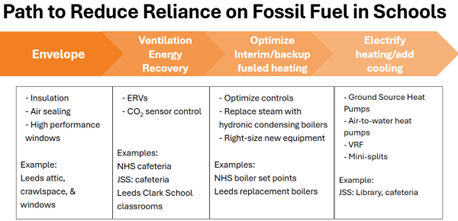
Ben advocated reuse of existing systems where possible but reducing the loads they must serve.
Ben also recommended having a well-thought-out controls system integrated into your plan from the beginning. While your utility company will pay up to 60 percent of a whole building controls system (BMS) if the current system is more than 15 years old, such a complex system may not be the best option. WIFI-connected remotes could be used to control mini-splits. Additionally, Mass Save has a Qualified Product List that offers savings on modular solutions made from standard components.
Ben explained that the cost-effective improvements at the Leeds Elementary School not only reduced the district’s annual spending on heating and cooling costs but also put the city one step closer to the goal of being a Net Zero community by 2050.
Following Ben’s discussion about Northampton’s path, Pat Smith and Bruce Scherer, members of the School Building Committee for the Town of Orange, detailed their experiences in working with the MSBA to plan, design and construct an addition/renovation project at the Fisher Hill Elementary School.

Pat Smith shared Orange’s path, including a failed vote on its first attempt to garner support for a school project 10 years earlier. Pat explained that in the interim 10 years, costs escalated significantly. However, she shared how a robust feasibility study with the pros and cons of numerous grade configurations, design options and sites as well as a concerted effort at outreach to Town organizations and voters were paramount to getting to an overwhelming “yes” vote the second time around. Pat shared how much the updated school is respected by staff, students, and the community for the modern, light-filled learning environment that now exists. She expects it will be a beacon of light to show prospective young property owners signifying that the Town of Orange cares deeply about education and is a great place to raise a family.
Pat opined that while an addition/renovation project requires careful phasing with relocating students and staff, this option can provide a more affordable alternative for rural districts looking to upgrade school facilities. Serving 450 students and covering 86,000 SF, the updated Fisher Hill Elementary School (2023) expects to achieve LEED Silver certification with the installation of solar PV, on track to be completed later this year.
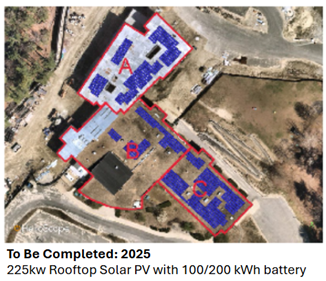
The district took Dexter Park Elementary School off-line and consolidated students into the expanded Fisher Hill Elementary School. Operational cost savings from the two-school consolidation as well as the operational savings expected with the new solar installation at Fisher Hill will benefit budgets for years to come.
Bruce Scherer emphasized the importance of understanding the length of time needed for required studies to support an agreement with the utility company to connect the all-electric project with the electrical grid. The MSBA’s project timeline is not easily adjusted once underway. Knowing early on that the district wants to include a PV installation as well as decisions on whether it will be operated by the district or in accordance with a Power Purchase Agreement is key to a smooth integration of the utility’s requirements and the MSBA’s timeline for design and construction.

Using funding sources including federal tax credits from the Inflation Reduction Act, the Town of Orange opted to own /operate the photo voltaic system. It took advantage of a pilot program offered by National Grid and built a “behind-the-meter” system which requires battery storage. Bruce emphasized the value of becoming a member of the nonprofit energy-buying consortium, PowerOptions, which provided the district with necessary guidance and information about beneficial cost savings.
Finishing up the second session, Tammy Tefft, Chief Procurement Officer for the City of Westfield, detailed the city’s path in funding its share of construction cost for the new Westfield River Elementary School (2025). Working with the MSBA, Westfield was able to consolidate two aging elementary schools into one new modernized, energy-efficient facility.
The city built a state-of-the-art elementary school for a rough cost of $61 million. The MSBA partnered with the city and provided a grant of $35 million. The City’s reimbursement rate for eligible expenses is 77 percent.
To convince the City Council to vote in favor of a project, Tammy echoed Pat Smith regarding keys to success – engage all aspects of the community/stakeholders about the need for a school building project and answer all questions in a transparent manner.

Westfield’s City officials all worked together to find a means to cover the city’s share of the cost of a new school. A creative bonding strategy from the Treasurer, use of Free Cash for furniture and equipment, use of the food service budget for cafeteria furniture and use of E-Rate funding for technology were all included in the practical approach to financing the City’s share of the new school project. (Tammy emphasized that use of Community Preservation Act funding for playgrounds would also be permissible.) The new school serves the downtown area with most students coming from economic justice neighborhoods surrounding the school. The school is walkable from a good portion of the city and is expected to be a focal point of the community. It replaces two old, crowded and outdated schools. Cost savings for the school department include the overall cost of maintenance of those old facilities. Citizens will also see a decrease in the overall need for fossil fuel.
Funding Sources

Opening Session Three, Mary Pichetti, Executive Director of the MSBA, presented an overview of the MSBA’s two programs: Core Program and the Accelerated Repair Program. The MSBA offers districts these two flexible options to upgrade their school facilities. Mary also highlighted the MSBA’s cost saving Model School program, underscoring the advantages of a tried-and-true school building design for districts, including the advantage of being able to visit identical schools already in operation and to expedite the timeline to build a new school.
Next, Amanda Formica of National Grid shared the new opportunities available to Massachusetts schools through Mass Save, emphasizing the availability of grant programs such as the Municipal Energy Manager Competitive grant, the Portfolio and Project Planning Assistance program, and increased incentives for energy-efficient buildings utilizing electrification and heat pump systems.
Lastly, Meg Howard, Program Director for the Massachusetts Clean Energy Center (MACEC), offered insight into the organization’s assistance programs for Massachusetts schools, including technical assistance offerings supporting comprehensive building assessments, portfolio decarbonization roadmaps, and focused studies.